

 Tiếng Việt
The plastic packaging industry is undergoing a major transformation under the pressure of global competition, rising customer demands, and stringent requirements for quality and speed. In this context, automation has become an inevitable trend, helping businesses optimize processes, reduce costs, and improve production efficiency.
In the past, many stages such as injection molding, blow molding, printing, and packaging relied heavily on manual labor, which was prone to errors, time-consuming, and difficult to meet large orders. With advancements in technology, today’s plastic packaging factories are increasingly adopting industrial robots, fully automated production lines, and smart management systems.
This not only enhances precision in each product but also ensures consistency, thereby meeting international standards such as ISO and FDA. Automation is not merely a technological solution but also a strategic approach that enables businesses to survive and grow sustainably in the era of Industry 4.0.
Nội dung chính
Smart Production Lines and Robotics
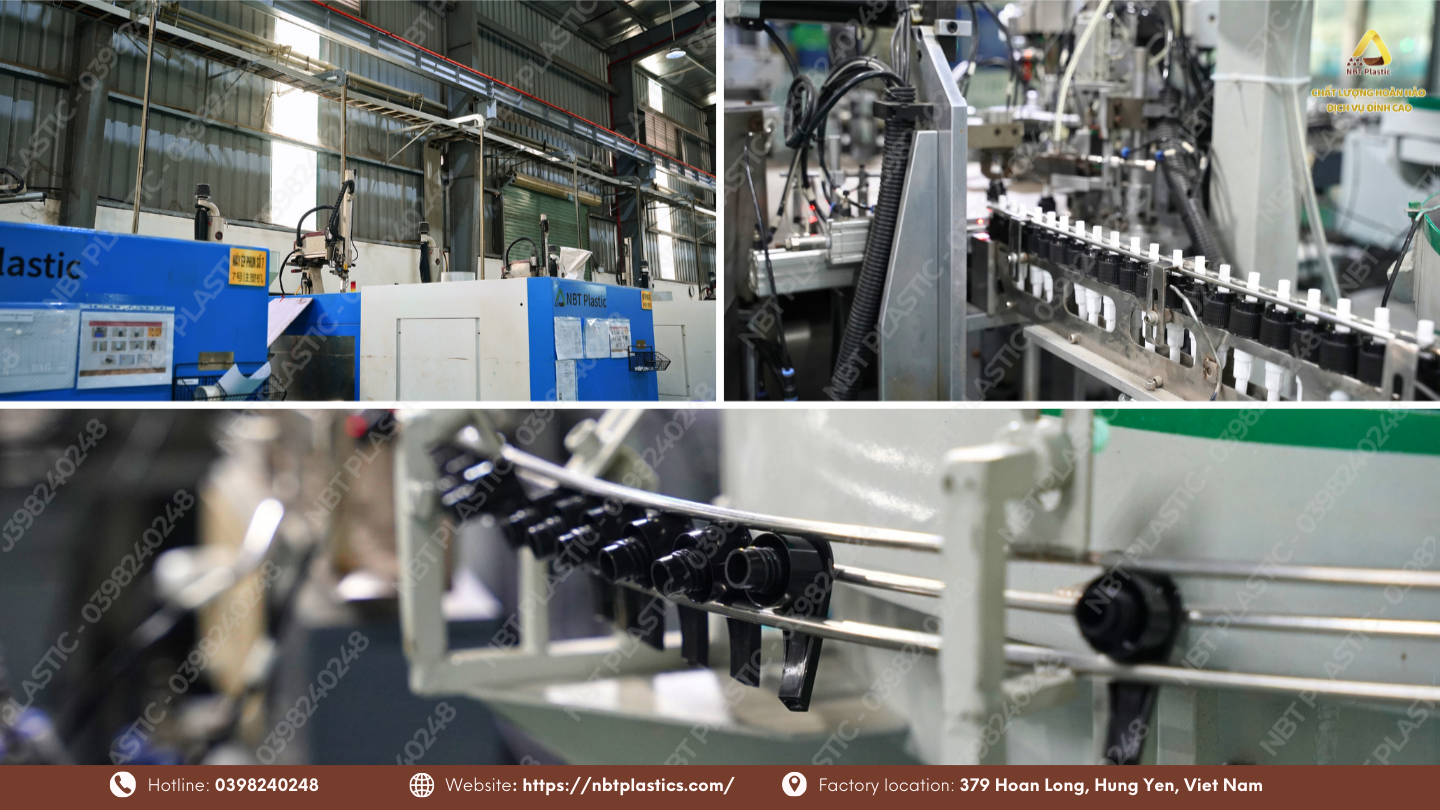
One of the most notable aspects of the automation trend in the plastic packaging industry is the emergence of smart production lines and robotics. Modern injection molding and extrusion blow molding machines are now integrated with sensors and automated controls, allowing precise monitoring of temperature, pressure, and production cycles. As a result, PET and HDPE plastic bottles are manufactured with high accuracy and minimal defects.
Industrial robots are applied in mold handling, product retrieval, and packaging, reducing dependence on manual labor. In addition, SCADA and IoT systems enable real-time monitoring of the production line, automatically issuing alerts in case of issues and optimizing machine performance.
Some advanced factories even apply AI and Machine Learning to analyze production data, predict potential defects, and suggest improvement solutions. Thanks to robotics and smart production lines, labor productivity increases multiple times, while production costs and defect rates are significantly reduced. This provides a strong foundation for plastic packaging businesses to compete not only domestically but also internationally.
Automation in Quality Control
Beyond production, quality control (QC) is also being automated to ensure product consistency. In the past, quality inspection relied heavily on the human eye and manual operations, which were prone to errors. Today, industrial cameras, laser sensors, and 3D measurement systems are integrated directly into the production line to check the dimensions, thickness, sealing, and surface of plastic bottles.
This allows product defects to be detected instantly and removed immediately, preventing large batches from being affected. Automated systems also have the ability to store data, enabling businesses to trace product origins and demonstrate compliance with ISO, GMP, or FDA standards when exporting.

Some advanced factories have even adopted blockchain technology to store production and quality data, ensuring absolute transparency for international customers. Automating quality control not only enhances brand credibility but also helps businesses save on warranty costs and minimize risks when competing in the global market. This is clear proof that automation is the key to ensuring quality in modern plastic packaging manufacturing.

NBT Plastic is not only focused on quality but is also committed to applying automation technology to develop eco-friendly packaging solutions, utilizing recycled materials and moving toward a green production model. Thanks to this approach, NBT Plastic has become a trusted partner for domestic brands while also strengthening its position in export markets. This is clear evidence that automation is the key to elevating Vietnamese plastic packaging enterprises in the era of global integration.